|
 |
|||||
 | ||||||




Who we are |

The heart and hands of FrutArt are Judit Comes, who comes from a family of artists and craftsmen. Her father, a cabinetmaker, introduced her to working with wood. At the age of 15, she trains at the Ondara School of Arts and the Lluïsa Serrando Academy of Drawing and Painting, where she develops her skills in design and graphic arts, sculpture, painting and ceramics. After finishing her studies, she explores new forms of expression, such as sculpture in clay, stone and wood, while at the same time discovering her passion for cooking and gastronomy. Over the following years she works as a graphic designer while taking part in various gatherings and gastronomic events. It is at this point that she begins to merge her two passions, art and gastronomy, expressing them in the decoration of cakes and pastries, and evolving towards advanced work with chocolate and other techniques. In early 2005, she has the opportunity to take a fruit carving course with master Xiang Wang. There she is able to practice the Chinese carving techniques and begin to work with fruits and vegetables in an artistic way. Practicing intensely and seeing her ease for this art, she decides to create FrutArt, in order to share and to collaborate with professionals and individuals in promoting a new vision of fruits and vegetables, as well as to encourage their consumption and improve their image. FrutArt collaborates with different organizations and companies, while attending various events to promote healthy eating, and providing decorations and training for companies and individuals. Judit has travelled to different places across Europe, showing and teaching people this beautiful millenary art. Lately she has been sought after by diverse media and cultural institutions to showcase her work and projects. |
Short history of fruit and vegetable carving |
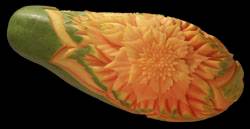
The art of carving fruits and vegetables began in China about 2000 years ago, for decorating dishes and events. Today carving is still practised regularly in restaurants and major celebrations. In Thailand this art was imported from China in 1364, when one of the palace princesses decorated a floating lamp (used in a traditional Thai ceremony) with figures carved from fruits and vegetables. On seeing it, the king was moved and promoted this art for exclusive use at the court. In 1932, the art of carving was "democratised", when the reigning King decided to spread it by training the country's school teachers. Thus it became one more of the official arts, like painting, music, dance, etc... The difference between Chinese and Thai carving lies basically in the motifs created. The Chinese make figures and images allegorical to their tales and legends, whereas the Thai mainly make flowers. |